



















THE EVOLVED EDIT
10,000mAh vs 20,000mAh Power Bank: Which Is Best?
Choose 10,000mAh for lighter daily carry or 20,000mAh for longer trips and more devices. Capacity, watt-hours and output all matter.

10,000mAh or 20,000mAh in one minute
- Choose 10,000mAh for commuting, a day out, lighter bags and mostly phone charging.
- Choose 20,000mAh for multi-day travel, several devices or a power bank with higher wired laptop output.
- Compare watt-hours and output too. Capacity tells you stored energy; it does not tell you charging speed.
- Expect conversion loss. You cannot divide the power bank's mAh by the phone battery's mAh and treat the result as guaranteed full charges.
10,000mAh vs 20,000mAh power bank comparison
| Factor | 10,000mAh | 20,000mAh |
|---|---|---|
| Best for | Daily phone charging and short trips | Longer trips, several devices and higher energy needs |
| Portability | Usually smaller and lighter | Usually larger and heavier |
| Stored energy | About half that of an equivalent 20,000mAh design | About twice that of an equivalent 10,000mAh design |
| Recharge time | Usually shorter with comparable input power | Usually longer with comparable input power |
| Airline category | Commonly below 100Wh | Commonly below 100Wh, but always read the label |
| Main tradeoff | Less reserve power | More weight and bulk |
What do mAh and Wh mean on a power bank?
Milliamp-hours (mAh) describe electrical charge capacity. The number is useful when comparing battery packs measured at the same internal cell voltage, but it is incomplete by itself.
Watt-hours (Wh) describe stored energy and include voltage. Wh is the figure airlines use for passenger battery limits. You can calculate it from the manufacturer's rated values:
Wh = (mAh ÷ 1,000) × nominal voltage
For example, the MagBank Qi2 Universal 10K is listed as 10,000mAh at 3.7V:
(10,000 ÷ 1,000) × 3.7 = 37Wh
The MagBank Universal 65W 20K is listed as 20,000mAh at 3.85V:
(20,000 ÷ 1,000) × 3.85 = 77Wh
Both listed figures are below the FAA's 100Wh threshold for spare lithium batteries, but they must still travel in carry-on baggage and meet all airline and route-specific requirements.
How many phone charges does 10,000mAh or 20,000mAh provide?
There is no honest universal number. Energy is lost as the power bank converts its internal cell voltage to USB output, through the cable or wireless transmitter, and again inside the phone. Heat, charging speed, battery age, background use and the phone's charging curve change the result.
Wireless charging normally loses more energy than a direct wired connection. That means a magnetic power bank may deliver fewer full charges wirelessly than the same pack would through USB-C.
As a decision rule, 10,000mAh suits one phone and regular access to outlets; 20,000mAh gives a larger buffer for multiple days or devices. Treat any exact “charges your phone X times” statement as an estimate only when it names the tested phone, connection method and conditions.
Capacity does not determine charging speed
A 20,000mAh power bank is not automatically faster than a 10,000mAh model. Charging speed depends on output power, supported protocols, cable, port and device input limit.
| Product | Capacity | Listed wired output | Listed wireless output | Notable design |
|---|---|---|---|---|
| MagBank Qi2 Slim | 5,000mAh or 10,000mAh | USB-C up to 20W | Up to 15W | Slim magnetic daily-carry options |
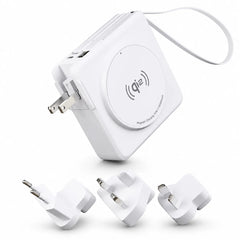
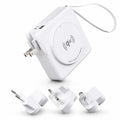
| MagBank Qi2 Universal 10K | 10,000mAh / 37Wh | USB-C up to 20W; USB-A up to 22.5W | Check current product page | Built-in USB-C and Lightning cables plus travel adapters |
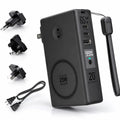
| MagBank Universal 65W 20K | 20,000mAh / 77Wh | USB-C up to 65W | Listed up to 25W | Higher-capacity travel and laptop-oriented output |
“Up to” figures require a compatible device and connection. A phone will not accept laptop-level power simply because a power bank can provide it.
Which capacity should you choose?
Choose a 10,000mAh power bank when:
- You carry it every day and prioritize lower weight.
- You mainly need phone top-ups between outlets.
- Your trips are short or you can recharge overnight.
- You want an integrated magnetic design without the bulk of a larger pack.
Choose a 20,000mAh power bank when:
- You travel for several days or spend long periods away from outlets.
- You charge a phone, tablet, earbuds and other devices from one pack.
- You need a model with suitable high-power USB-C output for a compatible laptop.
- You prefer a larger reserve over minimum bag weight.
Consider 5,000mAh when:
You only want a compact emergency top-up. The 5,000mAh version of MagBank Qi2 Slim is listed at 103g, compared with 185g for its 10,000mAh version. It carries less energy but may be the option you are most willing to bring every day.
Should you choose wired or wireless power?
Choose magnetic wireless charging for convenience and cable-free phone attachment. Choose USB-C when efficiency, lower heat or maximum supported output matters more. A hybrid power bank lets you use wireless for quick phone top-ups and a cable for faster or more energy-efficient charging.
If you use a case, make sure it supports the magnetic system and keeps the coils aligned. See whether wireless charging works through a phone case before building your setup.
Can 10,000mAh and 20,000mAh power banks go on a plane?
Under current FAA passenger rules, spare lithium batteries and power banks must stay in carry-on baggage. Batteries from 0–100Wh are allowed within the FAA framework, while 101–160Wh batteries require airline approval and are limited; larger spare batteries are forbidden. Airlines and other authorities can impose stricter rules.
The two Evolved examples above are labeled 37Wh and 77Wh. Do not rely on capacity alone: check the Wh label, condition of the product, airline policy, departure country, transit points and destination. Read the complete 2026 power-bank airline guide before flying.
Compare portable power by capacity and output
Browse Evolved magnetic power banks. Compare the printed Wh rating, device compatibility, wired and wireless output, dimensions, weight, ports and included accessories—not capacity alone.
Frequently asked questions
Is 20,000mAh twice as good as 10,000mAh?
It stores roughly twice the charge when cell voltage and design are comparable, but it is not twice as fast or automatically twice as useful. Portability, output, efficiency and your devices determine the better choice.
Can a 20,000mAh power bank charge a laptop?
Capacity alone is not enough. The power bank needs a USB-C output and protocol the laptop accepts, with enough wattage and a suitable cable. The MagBank Universal 65W 20K is listed with USB-C output up to 65W; check the laptop's exact requirement.
Why is the usable capacity lower than the label?
The rated cells operate at an internal nominal voltage, while USB output uses another voltage. Conversion, cable, heat and device charging all create losses. The mAh figures are therefore not directly transferable one-for-one.
How long does it take to recharge a power bank?
It depends on capacity, input wattage, adapter, cable and charging curve. A larger pack generally takes longer when both use the same input power.
Does a power bank lose capacity over time?
Yes. Rechargeable lithium batteries gradually lose usable capacity with charge cycles, age, heat and storage conditions. Follow the manufacturer's care instructions and replace damaged or swollen products.